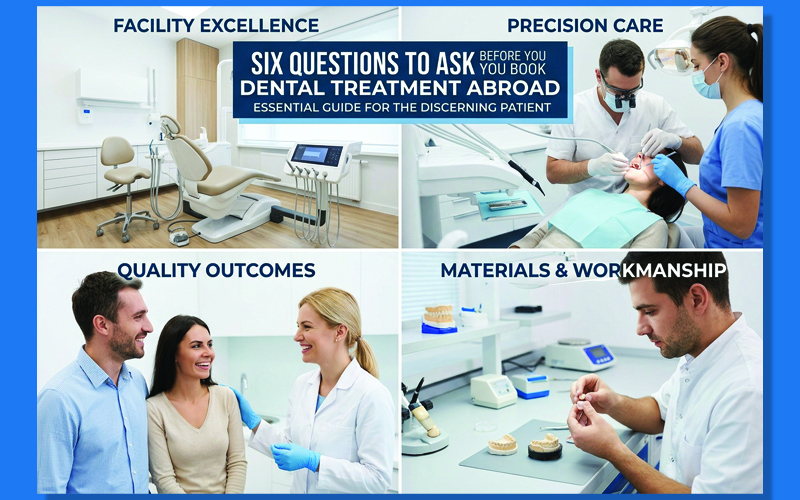
Cut through the marketing noise and evaluate dental tourism with confidence using these six critical questions
Most people research overseas dental treatment the same way. They open a browser, compare a few clinics, look at photographs, read reviews, and narrow the list based on price and the quality of the website.
Every part of that process is understandable, and almost none of it protects you.
Photographs are commissioned. Reviews are, at best, a lagging indicator and at worst purchased. Price tells you what you will pay and nothing about what you will receive. What actually protects a patient is knowing who is responsible for what, and that is not visible on a landing page. You have to ask.
Here are the six questions worth sending before you commit to anything. Send them in
1. Am I contracting with the clinic, or with an agency?
This is the question almost nobody asks, and it is the most important one on the list.
A large share of the treatment packages advertised online are sold by intermediary organizations — agencies that handle marketing, travel, transfers and accommodation, and then place you with a clinic. In Türkiye these agencies are licensed separately from the health facilities themselves, precisely because they are different things with different obligations.
There is nothing improper about the arrangement. The problem is not knowing you are in it. If your contract is with an agency, then the agency holds your commercial relationship while a clinic you did not choose holds your clinical outcome. When something needs attention two years later, you need to already know which door you are knocking on.
Ask directly: Is the company I am paying the same legal entity that will perform my treatment?
2. “Will I speak to the dentist who will actually treat me — before I book a flight?
Not a coordinator. Not a patient advisor. The clinician holding the handpiece.
A video consultation with the treating dentist is a reasonable minimum, and a serious clinic will offer it without being pushed. If every pre-treatment conversation runs through a salesperson and the dentist appears for the first time on the morning of surgery, you have learned something important about how that operation is structured.
3. What materials are being used for my treatment?
Implant brand, implant system, lot number, crown material, abutment type. In writing, before treatment.
This matters far beyond curiosity. Implant systems are not interchangeable — components, connections and prosthetic parts differ by manufacturer. If you ever need a repair, a replacement crown, or a component sourced by a dentist in your location, the first question your local dentist will ask is which system was used. “A good European brand” is not an answer that helps anyone.
You should leave the clinic with an implant passport. Ask whether you will.
4. Is this plan going to survive an actual examination?
Any treatment plan produced from photographs and a description is a preliminary estimate, and an honest clinic will call it that.
The plan should be built after clinical examination and 3D imaging, and it should be allowed to change if the imaging says something the photographs did not. Be more cautious, not less, about a plan that is quoted with total confidence from your phone camera. Certainty at that stage is a sales posture, not a clinical one.
Ask what happens if the examination changes the plan — specifically, how cost and duration are handled, and whether you can decline the revised plan.
5. What happens after I fly home?
The single most useful question, and the one most likely to produce an uncomfortable pause.
You want to know: who you contact from the United States and through which channel; what records are released to you and when; what is covered if something needs correcting; how long that coverage lasts; and, honestly, what the clinic cannot do from four thousand miles away.
The answer should exist before treatment and it should be written down. A clinic that has thought about this has a process. A clinic that has not will improvise, and you will be improvising with them.
6. Can my dentist at home read my file?
Whatever happens next in your dental life will happen in Nevada, not in Türkiye. Radiographs, treatment records, implant details and prosthetic specifications need to travel with you in a format your local dentist can open and interpret.
Ask for it as a condition, not as a favor.
What a good answer looks like?
You are not looking for six perfect answers. You are looking for a clinic that treats these as ordinary administrative questions rather than as friction — because that is what they are for an institution that does this properly.
A clinic that answers all six clearly and in writing may still not be the right clinic for you. But you will be choosing between real options instead of between photographs.
About RoselleDent
RoselleDent (Özel Roselle Dent Ağız ve Diş Sağlığı Polikliniği) is a licensed international health tourism facility in Karşıyaka, İzmir, and a member of the Turkish Chamber Las Vegas. The clinic works with international patients directly rather than through package resellers, operates under a named responsible manager, and maintains documented protocols for treatment planning, records handover and post-treatment follow-up.
You are welcome to send the six questions above to us before anything else. A video consultation with a treating dentist can be arranged before any travel commitment.
Web: roselledent.com | WhatsApp: +90 532 473 21 22 | E-posta: info@roselledent.com
Published for general information and not medical advice. Any treatment plan requires clinical examination and imaging. Individual outcomes vary.